



Employee Lockers: How to Choose the Right Workplace Locker
Why Employees Need the Right Lockers in Your Facility
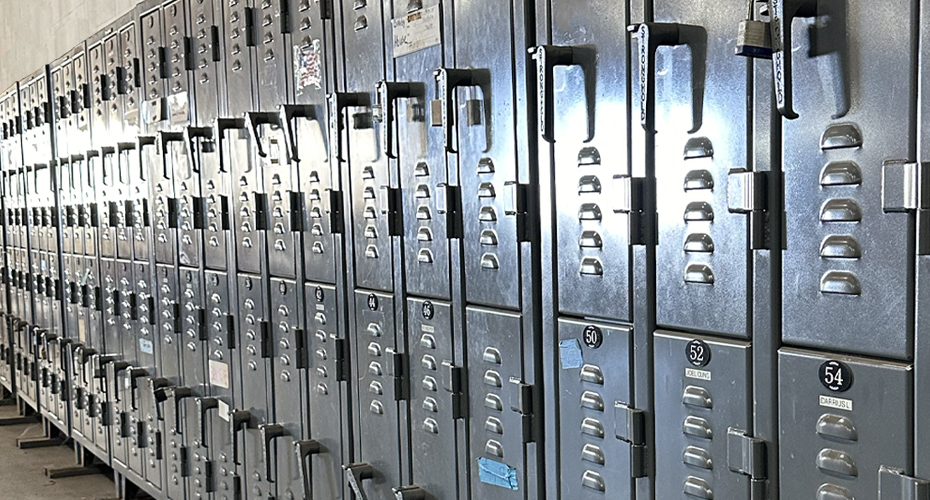
Employee lockers are often viewed as a simple workplace amenity, but in industrial environments they serve a much bigger purpose. The right locker system protects personal belongings, keeps work gear organized, supports safety initiatives, and creates a cleaner, more productive facility. Whether you operate a manufacturing plant, warehouse, utility, maintenance department, or government facility, investing in the right employee lockers can improve both day-to-day operations and employee satisfaction.
Modern employees bring more than a lunchbox to work. Steel-toe boots, hard hats, safety glasses, gloves, radios, tablets, uniforms, and personal belongings all need secure storage throughout the workday. Without dedicated lockers, these items often end up scattered around workstations, break rooms, or production floors, creating unnecessary clutter and increasing the risk of lost equipment.
Employee lockers also help establish accountability. When every employee has a designated place for their equipment and personal items, facilities become easier to organize and maintain. Work areas stay cleaner, shift changes become more efficient, and valuable PPE remains protected when not in use.
Perhaps most importantly, industrial facilities have unique storage demands that standard office or school lockers simply weren’t designed to handle. Manufacturing environments require stronger construction, better security, and features that accommodate work clothing, safety equipment, and heavy daily use. Choosing an industrial-grade locker ensures your investment will continue performing for years instead of needing frequent repairs or replacement.
Before purchasing employee lockers, it’s important to understand the different styles available and how each fits your workplace.
Why Employee Lockers Matter
Providing employee lockers isn’t just about giving workers a place to store their belongings; it’s about creating a safer, more organized, and more efficient workplace.
Secure Storage for Personal Belongings
Employees deserve a secure place to store wallets, keys, phones, medications, and other valuables while they work. Lockers reduce concerns about theft while preventing personal items from cluttering production areas.
Better Organization
When employees have designated storage space, uniforms, PPE, and work equipment stay organized and easily accessible. Instead of searching for misplaced gear before every shift, employees know exactly where everything belongs.
Cleaner Work Areas
Organized storage contributes to cleaner, more efficient facilities. Keeping bags, jackets, boots, and personal items out of workspaces reduces clutter and helps maintain a professional appearance throughout the facility.
Reduced Lost Equipment
Safety equipment and company-issued gear represent a significant investment. Dedicated lockers help reduce misplaced radios, handheld scanners, tools, PPE, and other equipment that often disappears when employees don’t have assigned storage.
Improved Employee Satisfaction
Small conveniences often have a large impact on workplace morale. Providing employees with secure, durable lockers demonstrates an investment in their comfort while making daily routines more convenient.
Supporting OSHA-Conscious Workplaces
Many industrial facilities require employees to wear specialized PPE or protective clothing. Dedicated lockers provide a clean, secure location to store work gear before and after shifts while helping employees separate personal belongings from workspace equipment.
Strong Hold Offers Different Types of Employee Lockers
One of the first questions buyers ask is:
What type of employee lockers should I choose?
The answer depends on what employees need to store, how much floor space is available, and whether lockers are assigned individually or shared across shifts.
Single-Tier Lockers
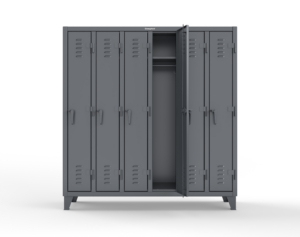
Single-tier lockers provide one full-height storage compartment for each employee. These are the most versatile option for industrial facilities where employees wear uniforms or require bulky PPE.
Single-tier lockers are ideal for storing:
- Full uniforms
- Jackets
- Steel-toe boots
- Hard hats
- Safety harnesses
- Rain gear
- Tool bags
- Personal backpacks
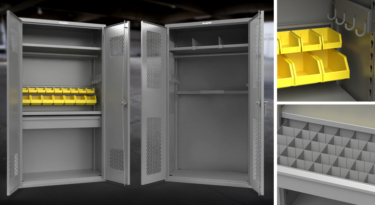
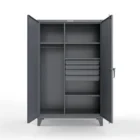
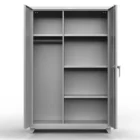
Many industrial single-tier lockers include garment rods for hanging uniforms, adjustable shelves for equipment, and coat hooks for jackets or PPE. This combination allows employees to keep work clothing clean, organized, and ready for the next shift.
If employees regularly change clothes at work, a single-tier locker is typically the best choice.
Double-Tier Lockers
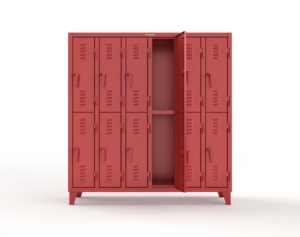
Double-tier lockers divide the same vertical footprint into two separate compartments, effectively doubling locker capacity.
Double-tier lockers are ideal when:
- Floor space is limited
- Employees don’t require full-length storage
- Uniforms are worn to work
- Only personal belongings need to be secured
Double-tier lockers commonly store:
- Lunches
- Small backpacks
- Wallets
- Keys
- Cell phones
- Light jackets
- Safety glasses
Facilities with office staff, warehouse associates, or employees who don’t change uniforms often find double-tier lockers provide an excellent balance between storage capacity and efficient use of space.
Triple-Tier Lockers
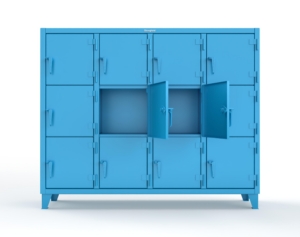
For facilities with large workforces, triple-tier lockers maximize storage density without expanding the building footprint.
They’re especially common in:
- Manufacturing plants
- Distribution centers
- Logistics facilities
- Shared work environments
- Large industrial campuses
Triple-tier lockers provide secure storage for personal belongings while allowing significantly more employees to utilize the same amount of floor space.
Although individual compartments are smaller, they’re often the most economical solution when employees only need to store personal items and smaller pieces of equipment.
What Employees Actually Store in Workplace Lockers
Another common question facilities managers ask is:
What should employees store in workplace lockers?
The answer varies by industry, but industrial lockers are designed to hold much more than personal belongings.
In manufacturing and industrial facilities, employee lockers commonly store:
Personal Items
- Wallets
- Keys
- Cell phones
- Watches
- Prescription medications
- Backpacks
- Lunches
- Water bottles
Personal Protective Equipment (PPE)
- Safety glasses
- Gloves
- Hard hats
- Hearing protection
- Face shields
- Respirators
- High-visibility vests
Work Clothing
- Uniforms
- FR clothing
- Jackets
- Rain gear
- Steel-toe boots
- Extra socks
- Coveralls
Company Equipment
Depending on the workplace, employees may also store:
- Two-way radios
- Tablets
- Barcode scanners
- Clipboards
- Flashlights
- Small hand tools
- Measuring equipment
Providing organized storage for all these items reduces clutter on the production floor while aligning with 5S principles and helping employees begin each shift prepared with everything they need.
It also reduces unnecessary replacement costs caused by damaged or misplaced equipment, while improving accountability for company-issued assets.
Features to Look for in an Industrial Employee Locker
Not all employee lockers are built to withstand the demands of an industrial workplace. While school or office lockers may work in low-use environments, manufacturing plants, warehouses, utilities, and maintenance departments require storage that can endure years of heavy use without compromising security or performance.
If you’re evaluating employee lockers, these are the features that make the biggest difference in long-term value and employee satisfaction.
Heavy-Gauge Steel Construction
One of the most important questions buyers ask is:
What gauge steel is best for employee lockers?
The answer depends on your environment, but for industrial facilities, thicker steel almost always delivers better long-term value.
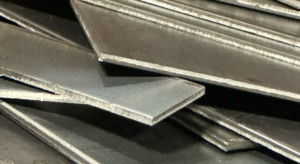
Steel gauge refers to the thickness of the metal used to construct the locker. Contrary to what many assume, a lower gauge number means thicker steel. Thicker steel provides greater resistance to dents, impacts, and years of daily abuse.
12-Gauge Steel Lockers
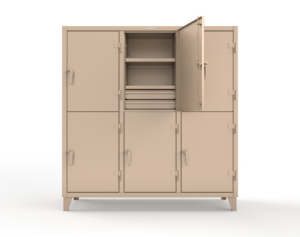
Twelve-gauge lockers are designed for the toughest industrial environments where maximum durability is required.
They are an excellent choice for:
- Manufacturing facilities
- Heavy industry
- Steel fabrication
- Mining operations
- Utilities
- Military installations
- Oil and gas facilities
12-Gauge Steel Lockers Benefits include:
- Exceptional resistance to dents and impacts
- Higher weight capacities
- Long service life
- Greater security
- Reduced maintenance over time
For facilities planning to keep lockers in service for decades, 12-gauge construction is often the best investment. As an added benefit, every Strong Hold 12-gauge steel locker comes with a 99-year warranty.
14-Gauge Steel Lockers
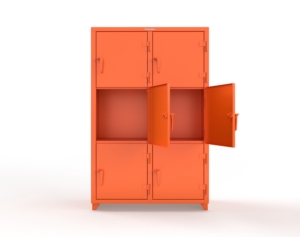
Fourteen-gauge lockers remain significantly stronger than the lighter-gauge lockers commonly found in schools or commercial buildings.
They’re ideal for:
- Warehouses
- Distribution centers
- Maintenance departments
- Municipal facilities
- Public works
- Commercial operations
They provide an excellent balance between durability, performance, and cost while standing up to demanding daily use. Every Strong Hold 14-gauge steel locker is backed by a 25-year warranty.
Locker Ventilation
Another common question is:
Are ventilated lockers better for manufacturing?
For many industrial facilities, the answer is yes.
Manufacturing employees often store sweaty uniforms, wet boots, rain gear, gloves, and other PPE that can trap moisture inside enclosed lockers.
Without proper airflow, moisture buildup can lead to:
- Unpleasant odors
- Mold and mildew
- Damp uniforms
- Rust on stored equipment
- Shortened life of PPE
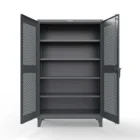
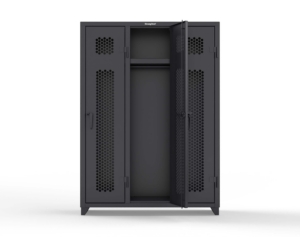
Ventilated locker doors promote continuous airflow, helping moisture escape while allowing equipment to dry between shifts.
Facilities that commonly benefit from ventilated lockers include:
- Manufacturing plants
- Food processing
- Utilities
- Construction operations
- Municipal maintenance departments
Many manufacturers offer ventilated door options that improve airflow without sacrificing security, making them an excellent choice wherever employees regularly store work clothing or protective equipment. Strong Hold ventilated door lockers also use a punched metal technique that provides greater longevity and security compared to expanded metal.
Locker Security and Access Control
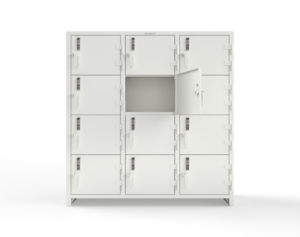
Employee lockers protect both personal belongings and valuable company-issued equipment.
The right locking system depends on your facility’s security requirements, employee turnover, and access control policies.
Padlock Compatibility
All Strong Hold lockers are designed to work with standard padlocks, allowing facilities to use existing security policies while giving employees control over their individual lockers.
This remains one of the simplest and most economical options.
Electronic Keypad Locks
Many buyers ask:
Do employee lockers need electronic locks?
Not every facility requires them, but electronic locks can offer significant advantages.
Electronic keypad locks eliminate lost keys and simplify locker management. Employees enter a code instead of carrying a physical key or padlock, while administrators can reset access when needed.
They’re especially beneficial for:
- High employee turnover
- Shared lockers
- Multi-shift operations
- Large manufacturing facilities
- Distribution centers
Access Control Systems
Some industrial facilities require even greater accountability.
Access control systems can integrate employee credentials, restrict locker access to authorized personnel, and maintain audit trails showing who accessed a locker and when.
These systems are commonly used in:
- Government facilities
- Military installations
- Pharmaceutical manufacturing
- Aerospace
- Utilities
- Critical infrastructure
If your facility must document access or secure sensitive equipment, electronic access control may be worth the investment.
Locker Durability
One final question buyers frequently ask is:
How long do industrial employee lockers last?
The answer depends on construction quality, but industrial-grade lockers are often designed to remain in service for decades with minimal maintenance.
Several factors contribute to locker longevity:
Thick Steel
Heavier-gauge steel resists dents, impacts, and daily wear significantly better than lighter-gauge alternatives.
Welded Construction
Rigid welded bodies are less likely to loosen over time than lockers assembled with bolts or rivets.
Heavy-Duty Hinges
8-gauge industrial hinges are engineered to withstand thousands of door openings each year without sagging or misaligning.
High-Quality Finishes
Durable finishes help resist scratches, corrosion, and chemical exposure while maintaining a professional appearance.
Built for High-Traffic Environments
Industrial employee lockers are designed for facilities where hundreds of employees access them every day. Choosing a locker built for continuous use reduces maintenance costs, minimizes downtime, and lowers the total cost of ownership over its lifespan.
Choosing the Right Employee Locker for Your Application
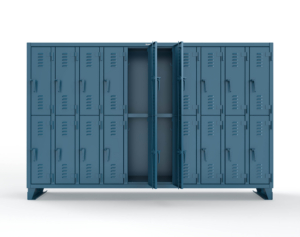
The best employee locker depends on the type of work your employees perform and what they need to store during each shift.
Manufacturing
Manufacturing employees often require full-height lockers capable of storing:
- Uniforms
- Steel-toe boots
- Hard hats
- Gloves
- Safety glasses
- Hearing protection
- Tool bags
Ventilated doors help wet PPE dry between shifts, while garment rods and shelves keep clothing organized.
Warehousing & Distribution
Warehouse employees typically need secure storage for:
- Personal belongings
- Lunches
- Two-way radios
- Barcode scanners
- Safety vests
- Jackets
Double-tier lockers are often a practical choice where floor space is limited and full-length garment storage isn’t necessary.
Maintenance Departments
Maintenance technicians frequently carry more equipment than other employees.
Their lockers often store:
- Boots
- Coveralls
- Hand tools
- Flashlights
- Spare clothing
- PPE
- Rain gear
Single-tier lockers with shelving and hooks provide the flexibility needed for a wide range of equipment.
Utilities & Energy
Employees in utility, electrical, and energy sectors commonly need storage for:
- FR clothing
- Helmets
- Rain gear
- Gloves
- Fall protection equipment
- Weather-resistant PPE
Heavy-duty steel construction and advanced locking systems help protect specialized equipment while standing up to demanding environments.
Military & Government
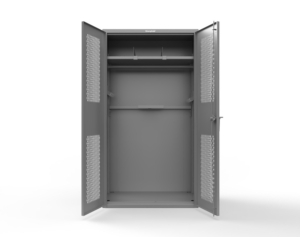
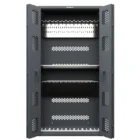
Government and military facilities often require enhanced accountability and secure storage for issued gear. TA-50 lockers may be ideal for their needs.
Common requirements include:
- TA-50 equipment
- Uniforms
- Personal gear
- Controlled access
- Audit trails
- High-security locking systems
Electronic access control and heavy-duty welded construction provide the durability and accountability these facilities demand.
Planning Your Locker Installation and Making the Right Investment
How Many Employee Lockers Do You Need?
One of the most common planning questions facility managers ask is:
How many employee lockers should a facility have?
The answer depends on much more than your current headcount. Taking a strategic approach now can prevent overcrowding, reduce future expansion costs, and ensure your locker installation continues meeting your needs for years to come.
Start with Employee Count
The simplest starting point is your total number of employees.
If every employee is assigned a dedicated locker, you’ll typically need one locker per employee.
However, that’s only the beginning of the planning process.
Consider Shift Schedules
Facilities operating multiple shifts often have opportunities to reduce the total number of lockers required.
For example:
- Facilities with dedicated day and night crews may require one locker for every employee.
- Operations where employees rotate through shared workstations may successfully use shared locker assignments.
- Temporary workers, contractors, or seasonal employees may benefit from flexible locker assignments instead of permanent ownership.
Understanding how your workforce actually operates can significantly improve space utilization.
Dedicated vs. Shared Lockers
Dedicated lockers offer several advantages:
- Employees always know where their belongings are stored.
- Personal organization improves over time.
- Employees can leave work gear between shifts.
- Less administrative oversight is required.
Shared lockers may be appropriate when:
- Multiple shifts use the same workspace.
- Storage needs are temporary.
- Facilities experience seasonal staffing fluctuations.
- Locker space is extremely limited.
While shared lockers can reduce upfront costs, many organizations find dedicated lockers provide a better employee experience and greater accountability.
Evaluate Available Floor Space
Before selecting locker styles, carefully measure your available space.
Questions to consider include:
- How much wall space is available?
- Will locker doors have enough clearance to open fully?
- Do walkways remain compliant with safety requirements?
- Will employees have room to comfortably access their lockers during shift changes?
Facilities with limited square footage often benefit from double-tier or triple-tier lockers that maximize storage without increasing the installation footprint.
Plan for Future Growth
Many organizations underestimate future hiring needs.
Adding lockers after installation often creates inconsistencies in appearance and layout while increasing installation costs.
Whenever possible, leave room for expansion or purchase systems that can grow alongside your workforce.
Think About Storage Requirements
The size of the locker should match what employees actually need to store.
This leads to another frequently searched question:
What size employee locker do I need?
The answer depends entirely on your application.
Choose a single-tier locker if employees need space for:
- Uniforms
- Jackets
- Boots
- Hard hats
- PPE
- Tool bags
A double-tier locker is often sufficient for:
- Lunches
- Backpacks
- Personal items
- Light jackets
- Small equipment
For facilities with large workforces and minimal storage requirements, triple-tier lockers maximize employee capacity while minimizing floor space.
Rather than asking which locker is “best,” ask which locker best matches what your employees use every day.
Questions to Ask Before Buying Employee Lockers
Before investing in new lockers, take time to evaluate your facility’s current and future needs. Asking the right questions now can help you avoid costly changes later.
Use this checklist during your planning process:
What needs to be stored?
Will employees store only personal belongings, or do they also need room for uniforms, PPE, tools, and work equipment?
Do employees change clothes at work?
If employees change into uniforms or FR clothing before each shift, full-height lockers with garment rods are typically the better choice.
Is ventilation necessary?
Facilities where employees store wet PPE, rain gear, or sweaty uniforms should strongly consider ventilated locker doors, or at least louvered doors, to improve airflow and reduce moisture buildup.
Are electronic locks needed?
Electronic keypad locks and access control systems make sense for facilities that require enhanced security, shared locker assignments, or audit trails.
How much space is available?
Carefully measure your available footprint before selecting locker configurations.
Will lockers need to be anchored?
Many industrial facilities anchor lockers for improved stability and safety, particularly in high-traffic or seismic areas.
How long should the lockers last?
This is one of the most important questions of all.
Choosing heavy-gauge, all-welded lockers may require a higher initial investment, but they often provide decades of dependable service while reducing maintenance and replacement costs.
Why Industrial Employee Lockers Outperform Standard Lockers
Not all employee lockers are built to withstand the demands of an industrial workplace. While standard lockers may be suitable for offices, schools, or recreational facilities, manufacturing plants, warehouses, maintenance departments, and utility operations require storage engineered for daily abuse and heavy use.
Industrial employee lockers are typically manufactured using heavier-gauge steel that better resists dents, impacts, and years of continuous use. Instead of relying on bolted construction, many industrial lockers feature all-welded bodies that provide greater rigidity and long-term structural integrity.
Hardware is equally important.
Heavy-duty hinges, American steel, and commercial-grade locking systems are designed to withstand thousands of open-and-close cycles while keeping employee belongings secure.
Many industrial lockers also offer advanced security features such as:
- Three-point locking systems
- Electronic keypad locks
- Access control integration
- Audit trails for controlled environments
Industrial lockers are also designed around the equipment employees actually use.
Rather than simply storing backpacks or books like school lockers, they accommodate:
- Uniforms
- Steel-toe boots
- Hard hats
- Gloves
- Safety glasses
- Radios
- Tablets
- PPE
- Hand tools
- Personal belongings
Interior features like garment rods, adjustable shelves, coat hooks, and drawers help employees stay organized while extending the life of expensive work equipment.
Finally, industrial lockers provide exceptional long-term value.
Their heavier construction minimizes maintenance, reduces replacement frequency, and delivers dependable performance in demanding work environments. Although they often cost more initially than lighter-duty alternatives, their lower lifetime ownership costs make them the smarter investment for industrial facilities.
Strong Hold Industrial Lockers Offer Reliable Storage and Long Term ROI
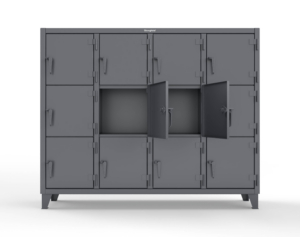
Employee lockers do much more than provide storage.
The right locker system improves workplace organization, protects employee belongings, supports safety initiatives, reduces clutter, and creates a more productive work environment.
Whether you’re outfitting a manufacturing facility, warehouse, maintenance department, utility operation, or government installation, choosing lockers built for industrial use ensures they’ll continue performing long after lighter-duty alternatives have failed.
As you evaluate your options, consider:
- What employees need to store
- Available floor space
- Security requirements
- Ventilation needs
- Steel gauge
- Construction quality
- Long-term durability
- Future workforce growth
By selecting heavy-duty employee lockers designed specifically for industrial environments, you’re investing in equipment that supports your employees and your operation for decades… not just a few years.
Explore Strong Hold Employee Lockers
Strong Hold manufactures heavy-duty, all-welded employee lockers designed for the toughest industrial environments. Built from American steel and shipped fully assembled, our lockers are available in multiple configurations, including single-tier, double-tier, and triple-tier models, with options for ventilated doors, garment storage, electronic keypad locks, and configurable interiors.
Whether you’re outfitting a small maintenance shop or an entire manufacturing campus, Strong Hold offers durable storage solutions built to organize your workforce and stand up to years of demanding daily use.
Explore our complete line of industrial employee lockers and find the right solution for your facility.
- Explore Strong Hold Industrial Lockers
- Get a Quote on Strong Hold Industrial Lockers
- Contact Your Preferred Strong Hold Dealer